

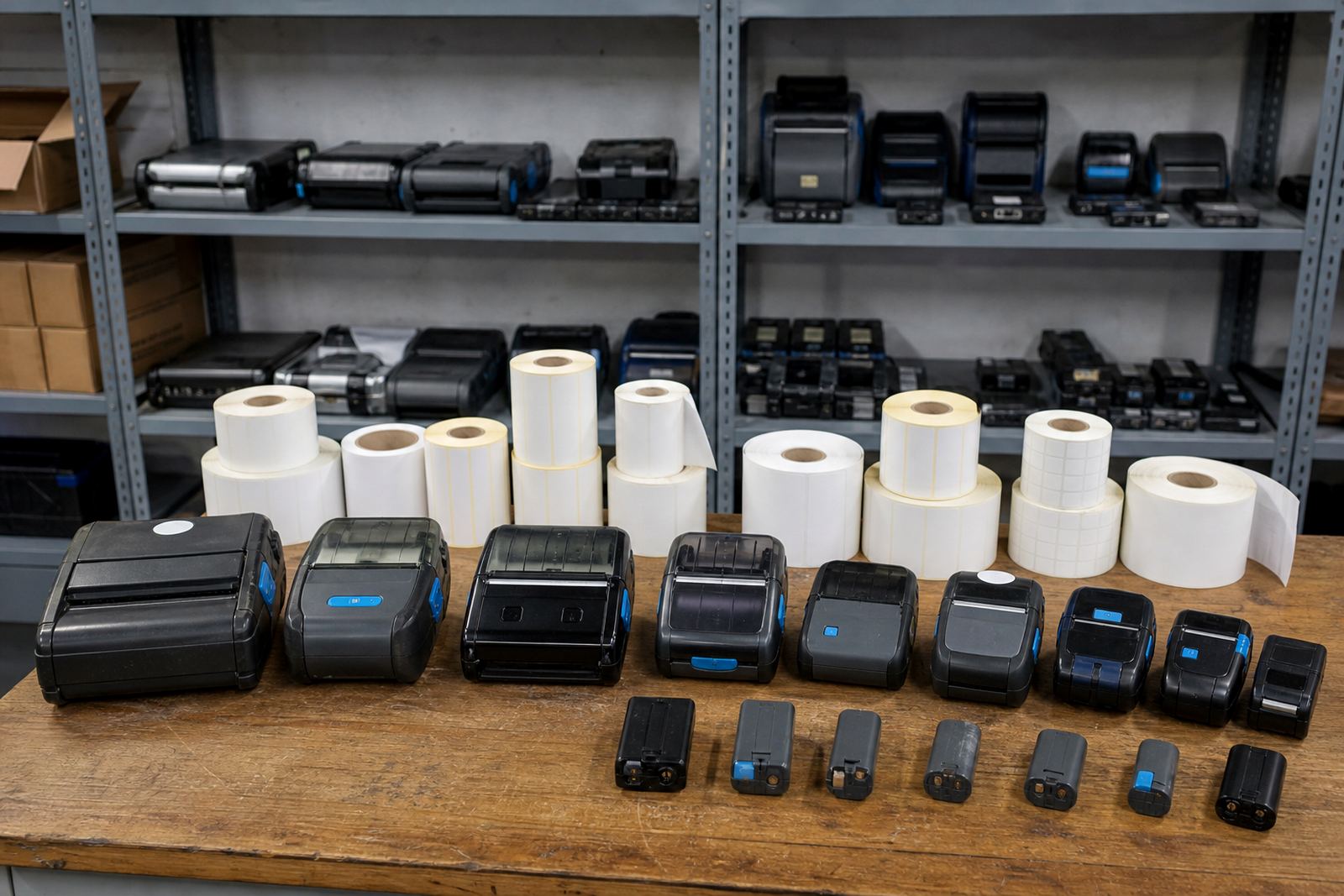
A Cape Town base built around working stockrooms
The first jobs came from places where labels had to survive handling, movement and routine checks at pace. That meant direct thermal rolls for short-life labels, thermal transfer rolls for tougher labels, battery checks and belt clip repairs that keep handheld units ready for a full shift. From the start, the work was shaped by real conditions in Montague Gardens and not by showroom talk.
The business took shape around the daily needs of warehouse supervisors, courier runners and retail teams. They wanted mobile printers that paired properly, printed clean barcodes and QR codes, and kept the label size consistent across shelves, cartons and dispatch bins. That practical mix still sits at the centre of how the team works today.
- Mobile label printers set up for barcode and QR code work
- Direct thermal and thermal transfer label rolls matched to the job
- Battery testing, replacement and belt clip repairs on site
How the work grew beyond the first batch of printers
As more sites called for help, the service side grew in step with the supply side. A printer that looks fine on a shelf can still struggle with the wrong label stock, a weak battery or a dirty printhead. That is where calibration, print quality fixes and printhead cleaning became part of the normal routine rather than an afterthought.
The team learned to consider the complete setup. Bluetooth pairing had to hold steady for mobile use, Wi-Fi setup had to suit the local network, and label sizes had to match the stock code system already in place. Once those details were sorted, operators could print labels that made sense for despatch, receiving and shelf control.
- Bluetooth pairing for mobile use across storerooms and dispatch areas
- Wi-Fi setup where printers sit on shared networks
- Label calibration for consistent print placement and size
The customers who shaped the business
Warehouses needed labels that stayed readable through handling, dust and frequent movement. Couriers needed compact mobile printers that could travel with the driver and still produce clear labels. Retail stockrooms needed labels that matched product bins, backroom storage and receiving tables without wasting rolls or slowing the team down.
Those users shaped the range far more than any sales plan did. The job was never just to hand over a printer. It was to make sure the unit, the battery, the roll type and the operator all worked together in the same space. That is still why the team spends time on training and setup, not just on supply.
- Warehouses needing daily stock and dispatch labels
- Couriers needing portable printers with dependable battery life
- Retail stockrooms needing tidy labelling at point of use
The people who handle the day-to-day work
The team today carries different parts of the same job. Mandla Mthethwa leads the business direction, while Anele Ntsele keeps operations tight and practical. Kagiso Ngwenya handles field service work, Leanne Hlongwane keeps the label supply side organised, Siyabonga Adonis leads technical support and Zinhle van Wyk handles training and setup with the people who actually use the printers.
That structure matters because no two sites behave in quite the same way. One branch may need printhead cleaning and battery testing, while another needs belt clip repair, label jam clearing and a fresh operator refresher. Having the right person handle the right part of the job keeps the service tied to what the site needs, rather than guesswork.
- Mandla Mthethwa guiding the business from the Montague Gardens base
- Field, technical and training roles split across the main service areas
- Support that covers both equipment and label supplies
What the team keeps checking on a real site
Printers can drift out of line slowly. A roll feeds badly, a battery starts dropping off sooner than expected, or labels print light on one edge and dark on another. The team built its service habits around those small faults because they usually show up in the middle of ordinary work, not during a quiet moment.
On-site setup often includes a few basics that make a real difference. The printer has to suit the label width, the roll must load cleanly, and the operator needs to know how to clean the printhead before build-up turns into faded print. Those details are plain work, but they save time and wasted stock.
- Battery testing and replacement where runtime has dropped off
- Print quality fixes for pale, streaked or uneven output
- Label jam clearing before the unit starts wasting rolls
How the label side stayed practical
Label supply grew alongside the equipment because the wrong roll can undo a good printer setup. Direct thermal labels suit shorter-life work, while thermal transfer labels suit more demanding jobs where print longevity matters. The team keeps the conversation practical: label size, adhesive, print width and the environment where the label will sit all matter.
That approach fits South African sites where dust, heat, humidity and handling vary from one location to the next. A stockroom in Cape Town may need a different label choice from a warehouse in Durban, and a courier route in Johannesburg can need a different battery and clip arrangement from a retail back office in Pretoria.
- Direct thermal rolls for quick, short-life label work
- Thermal transfer rolls for tougher, longer-lasting labels
- Advice based on label size, printer width and daily use
Where the story stands now
Today the business serves sites from Montague Gardens across Cape Town, Bellville, Midrand, Johannesburg, Durban, Pretoria and Gqeberha. The shape of the work has not changed much at its core. It still comes down to getting mobile printers installed properly, keeping rolls matched to the job and making sure the people using the equipment know how to keep it running cleanly.
That is the story in plain terms. A Cape Town base, a working team, and a service built around labels that have to print clearly on the first pass. The older habits still matter because the floor still asks for the same things: clear codes, steady output and hardware that holds up under daily handling.